
Rack power and cooling
Confirm the circuits, PDU capacity and cooling per rack. Large systems need 200–240 V high-current feeds and strong front-to-back airflow.
Rack · tower · GPU servers · enterprise storage
Price Beat Promise: show us a lower written quote and we will beat it
Every configuration confirmed in writing
Accelerated computing
We source servers with two to eight accelerators for inference, model training, rendering, video processing and scientific computing. Every request starts with two checks: whether your facility can power and cool the system, and whether the accelerator, destination and end user pass export-control review. Only then do we quote.
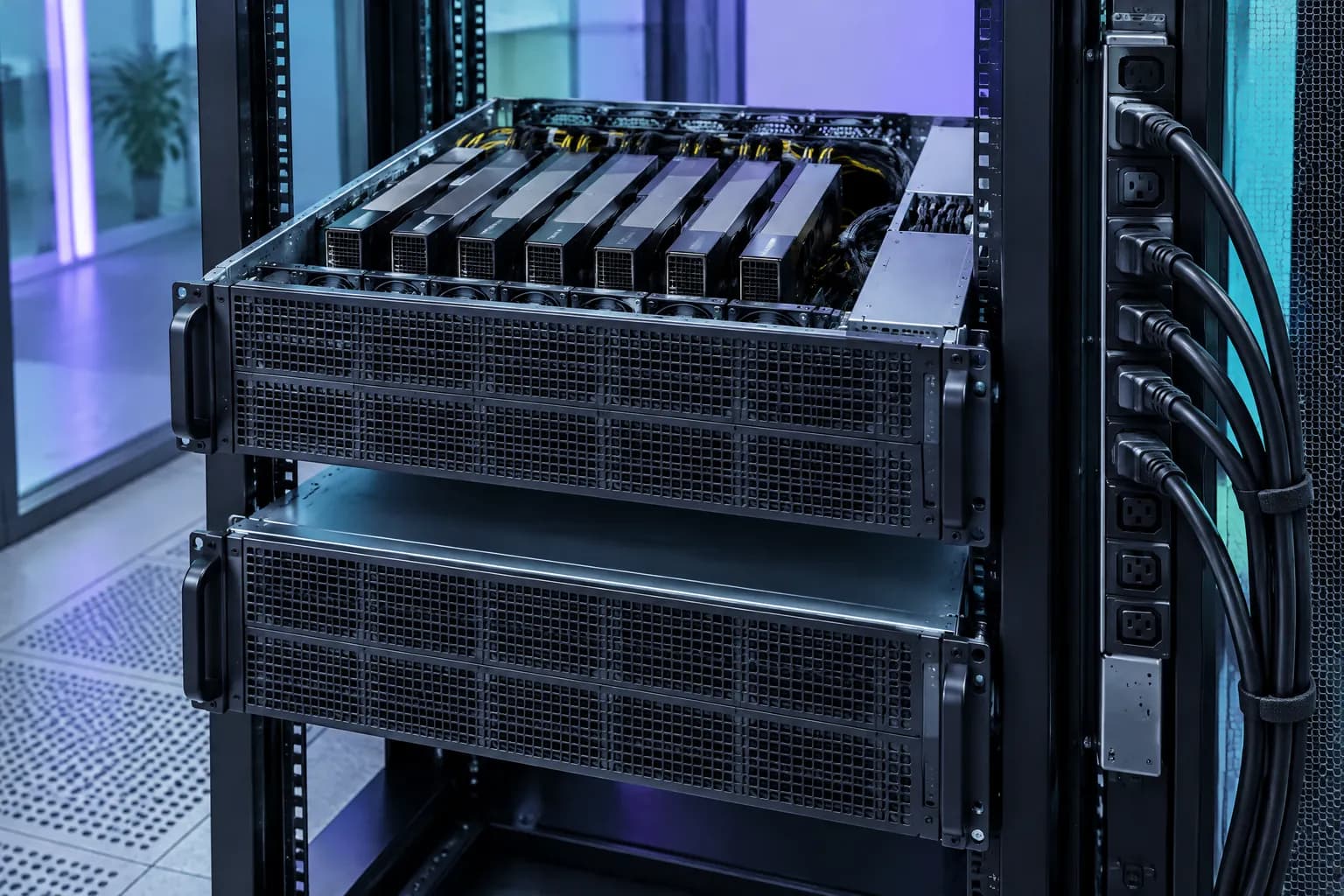
An accelerator server is a different animal from a standard 2U host. The largest systems draw several times the power, push far more heat out of the back of the rack and need high-current circuits that many server rooms were never wired for. A cheap quote is worthless if the facility cannot feed the system, so we confirm the maker's power and airflow figures for the exact configuration before anything else.
The workload decides the platform. Inference, video analytics and virtual desktops usually run well on PCIe cards in 2U or 4U servers. Training large models across many accelerators calls for boards linked by high-bandwidth fabrics such as NVLink and fast networking between servers. Tell us the models, frameworks and data sizes, and we propose platforms that fit rather than the biggest box available.
Export controls apply to many data-centre accelerators and the servers built around them. United States rules on advanced computing items follow the hardware when it is re-exported from the UAE, and some destinations or end users need a licence or cannot be supplied. We screen every request, ask for end-user and end-use statements, and tell you plainly when a request cannot go ahead.
These four checks come before model choice. Getting them right early saves weeks of back and forth.
Confirm the circuits, PDU capacity and cooling per rack. Large systems need 200–240 V high-current feeds and strong front-to-back airflow.
Share the end user, end use and final destination early. The review decides which accelerators can be quoted at all.
Match accelerator memory and interconnect to the workload: PCIe cards for inference, linked boards for large-scale training.
Multi-server jobs need fast fabrics and quick access to data. Plan the adapters, switches and NVMe storage with the servers.
The more of this you can share, the faster the export review and the quote. Leave blanks where you want our proposal.
The same four checkpoints keep the sample, contract and commercial lot aligned.
We confirm power and cooling figures with you and screen the request against export-control and sanctions rules.
Suppliers confirm configurations that fit the workload and the rack, and we compare them in one written quote.
The supplier assembles the system, runs accelerator stress tests and records thermals and firmware.
Heavy chassis ship on pallets in reinforced cartons, with accelerators fitted or packed as the maker recommends.
It depends on the accelerator, the destination and the end user. PCIe inference cards are often straightforward; the most advanced data-centre accelerators are tightly controlled. We review each request before quoting and decline what cannot be supplied lawfully.
It varies widely with the accelerator count and model, and the biggest systems need several high-wattage supplies on 200–240 V. We give you the maker's figures for your configuration.
Sometimes, mainly previous-generation PCIe systems when suppliers offer them. They come with an accelerator health readout, and the export review still applies.
Send the models or specifications, quantities, condition, destination and timeline. Our sourcing desk checks availability with suppliers and replies with written options.
Servers Dubai is an independent trader and is not affiliated with, authorised by or a partner of Dell, HPE, Lenovo, Supermicro, NVIDIA, AMD, Intel or any other manufacturer named on this page. Product names are trademarks of their owners, used only to describe the equipment buyers ask us to source. Warranty and support depend on the source of each unit and are stated per quote.