

Before you choose a GPU server, confirm three things in this order: that the rack can supply and remove the power the configuration draws, that the accelerators can lawfully be exported to your site and end user, and only then which accelerator, interconnect and platform best fit the workload.
GPU servers are the most demanding purchase a server buyer makes. They are heavy, power-hungry, often scarce and frequently subject to export rules. Buyers who start from the model name tend to discover the hard limits late. Buyers who start from the room and the rules get to a sensible order faster.
How much power will the rack need?
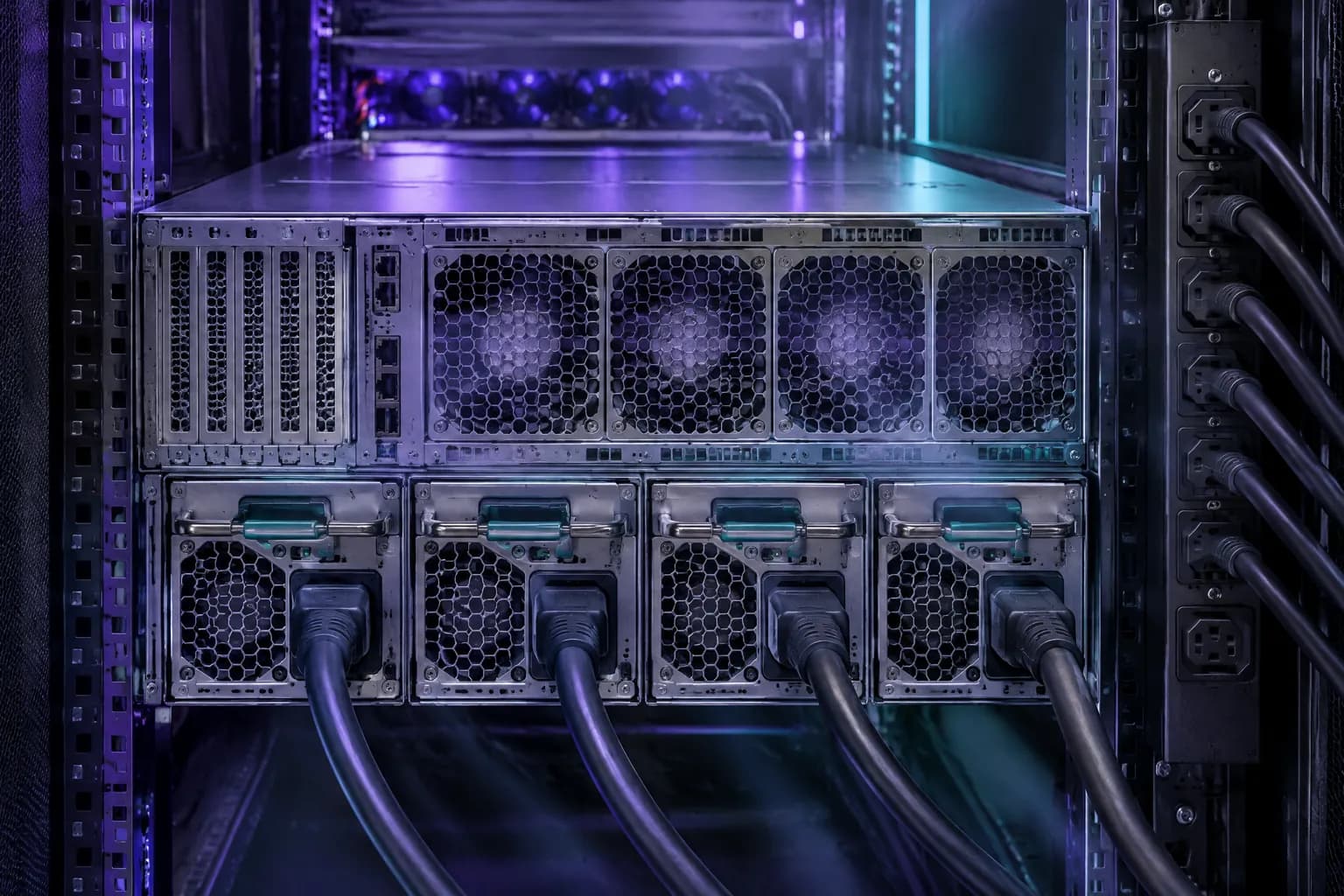
Accelerator servers span a huge range. A 2U server with two low-power inference cards behaves much like any other server. A 4U system with eight full-power cards, or an 8U system with an eight-accelerator board, can draw on the order of ten kilowatts at full load and needs several high-wattage supplies on 200–240 V circuits. Many older server rooms were designed for far less per rack. Ask your facility team for the power and cooling available per rack before choosing a platform, and compare it with the maker's figures for the exact configuration.
| Tier | Typical form | Planning notes |
|---|---|---|
| Inference | 1U–2U, 1 to 4 PCIe cards | Often fits standard racks; check supply rating |
| Mid-range | 4U, 4 to 8 PCIe cards | High-current 200–240 V circuits, strong airflow |
| Training | 6U–8U, 8-accelerator board | Dedicated power design, often only one or two per rack |
What about cooling?
Every watt drawn becomes heat at the back of the rack. GPU servers need a clear front-to-back airflow path, blanking panels in empty rack units and ideally hot-aisle or cold-aisle containment. The newest high-density systems increasingly use direct liquid cooling, which needs facility plumbing. If the room cannot remove the heat, the accelerators will throttle and the investment is wasted.
Why do export controls come before the quote?
Many data-centre accelerators, and servers that contain them, are controlled under United States export regulations on advanced computing items. Those rules follow US-origin technology when it is re-exported from a third country such as the UAE, and they have been revised repeatedly in recent years. Depending on the accelerator, the destination and the end user, a shipment may go ahead normally, need a licence, or be prohibited. The UAE also applies its own export-control law.
- We screen every GPU request against export-control and sanctions rules before quoting.
- We ask for the end user, the end use and the final destination in writing.
- Where a licence would be needed, we explain that before any commercial discussion, because licences take time and are not guaranteed.
- We decline requests that cannot be supplied lawfully, and we do not suggest ways around the rules.
PCIe cards or linked accelerator boards?
PCIe accelerators slot into standard servers and suit inference, video analytics, virtual desktops and many research codes that fit in one card's memory. Training large models across many accelerators benefits from boards where accelerators are linked by high-bandwidth fabrics such as NVLink, giving them a shared pool of fast memory. Those systems cost more, draw more and are more tightly controlled, so be sure the workload needs them.
Do not forget networking and storage
A fast accelerator waiting on data is an expensive heater. For multi-server training, plan high-speed adapters and switches, often 100 GbE and above or InfiniBand, alongside the servers. For storage, put fast NVMe in each server for active datasets and plan shared storage that can feed several servers at once. Switches and optics are covered by our sister site Network Supply Dubai.
What to send with a GPU server request
- The workload and software, and the memory each job needs
- Accelerator preference or class, and count per server
- Rack power and cooling available, and supply voltage
- Networking between servers and to storage
- End user, end use and final destination for the export review
- Quantity, condition and delivery terms
Related reading

Leave a Comment
Your email address will not be published.