

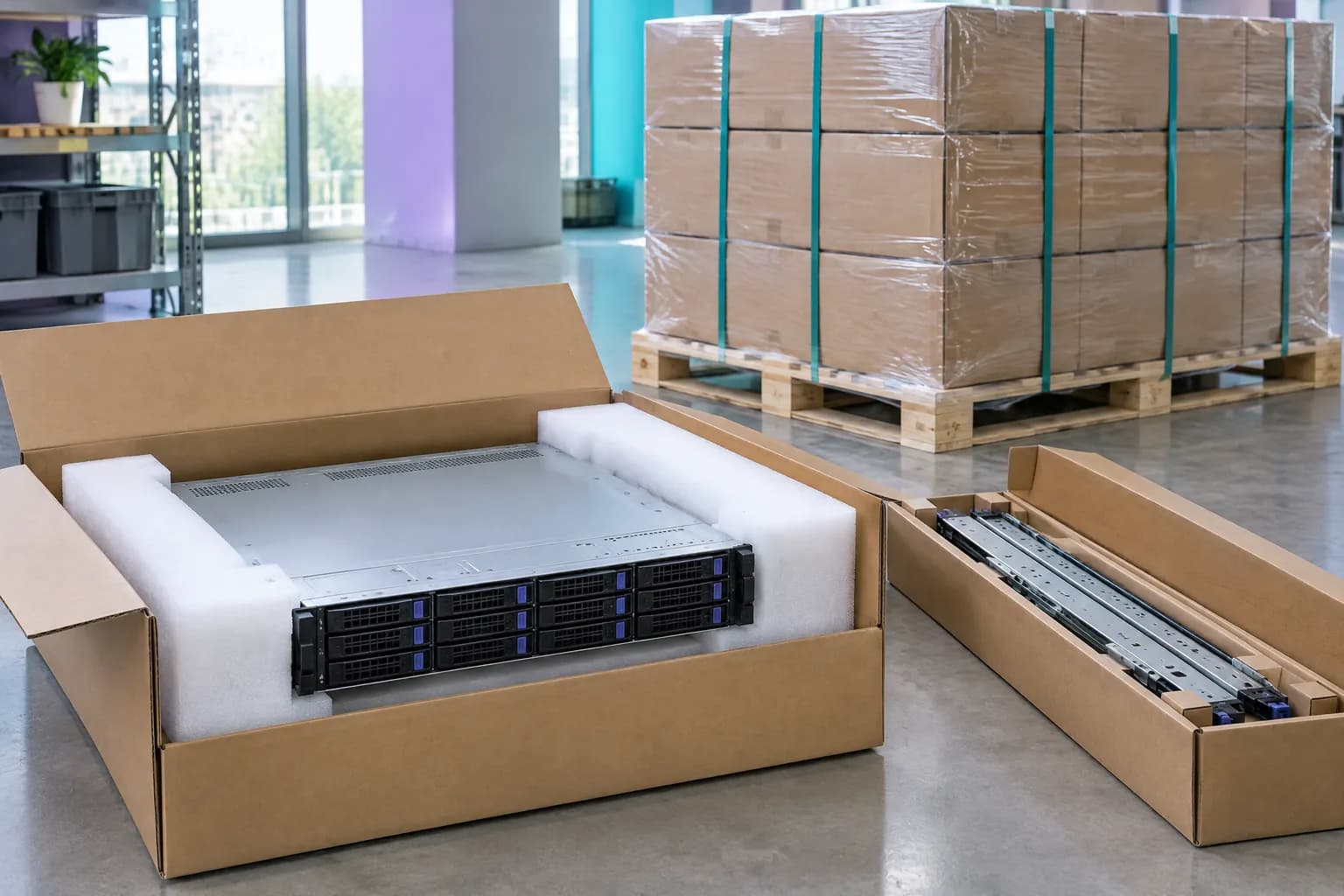
Ship servers from Dubai in individual foam-lined cartons, with rails boxed separately and multiple units strapped to heat-treated pallets; send spares and small urgent orders by air from DXB or DWC, and full pallets or heavy storage by sea from Jebel Ali, with the document set agreed before the goods leave.
Servers are dense, heavy and full of parts that dislike shock. Most transit damage comes from poor packing rather than rough handling, so getting the packing right matters as much as choosing the route.
How should a server be packed?
- One server per carton, in the maker's packaging or an equivalent carton with moulded foam end caps.
- Rails, cable arms and bezels in their own boxes, labelled with the server serial they belong to.
- Drives either fitted and secured, or packed separately in protective trays, as agreed for the route.
- Spare parts in anti-static bags, boxed and labelled by part number.
- Heavy 2U and 4U units palletised, never stacked loose in a container.
What makes a good server pallet?
Use pallets that meet ISPM 15, the international standard for wooden packaging, which means heat-treated or otherwise treated wood carrying the official mark. Stack the heaviest cartons at the bottom, keep the load within the pallet footprint, add corner boards, stretch-wrap and strap the cartons to the pallet. Mark the pallet with orientation and handling labels, and list each pallet's contents on the packing list.
Air or sea?
| Air from DXB or DWC | Sea from Jebel Ali | |
|---|---|---|
| Suits | Spares, drives, a few servers, urgent orders | Pallets of servers, racks of equipment, storage shelves |
| Charged on | The greater of actual and volumetric weight | Volume or container, LCL or FCL |
| Handling | Fewer touches, faster transit | More handling at ports, longer transit |
| Typical Incoterms | CPT or CIP to the destination airport | CFR or CIF to the destination port, or FOB Jebel Ali |
Air freight is priced on chargeable weight, which is the greater of the actual weight and a volumetric weight calculated from the carton dimensions. Bulky server cartons often hit the volumetric figure first. Sea freight is priced by volume for shared containers or per container for full loads, and usually wins once an order fills a pallet or two.
What about batteries?
Servers normally contain only a small coin cell for the clock, and many RAID controllers protect their cache with capacitors rather than batteries. Separate battery packs, cache battery modules and UPS batteries are different: they are packed and declared to the transport rules for their type by the supplier and forwarder. If your order includes UPS units, sea freight is often the simpler route for the batteries.
Insurance
Under CIF and CIP the seller arranges insurance to the destination; under other terms, the buyer should. Either way, make sure the insured value reflects the real value of the servers, and photograph pallets at handover so any damage claim has evidence.
Which documents travel with the servers?
- Commercial invoice and packing list, with model and part numbers per carton
- Serial list covering every chassis and drive
- Certificate of origin where the destination requires it, issued through the Dubai Chamber system for re-exports
- Air waybill or bill of lading
- Test logs and drive sanitization records for refurbished equipment
- Any pre-export certificate the destination programme requires
Send copies to your clearing agent before the goods arrive. Most clearance delays come from documents that reach the agent late or do not match the cargo.
Related reading
Leave a Comment
Your email address will not be published.